SERVICE STATE
CONNECTING
Connecting to the official DDAD inference service
OFFICIAL CHECKPOINT — · FEAT —
MVTec AD · Hazelnut · Research interface
Conditioned denoising diffusion reconstructs nominal appearance, then exposes the visual evidence it cannot explain.
Open analysis workspaceSecure inference workspace
Images are sent through a protected site endpoint to the official DDAD model. Server credentials never enter your browser.
Drop a Hazelnut image into the laboratory
or choose a PNG, JPEG, or WebP · max 10 MBConnecting to the official DDAD inference service
Instrument readout
Connecting to the official DDAD inference service
Visual evidence stack
Choose a Hazelnut image to begin
The untouched observation supplied to the reconstruction pipeline.
Model output will appear here
A conditioned estimate of the nominal surface generated by the official checkpoint.
Anomaly evidence will appear here
Pixel and feature discrepancy fused into a spatial explanation of the final score.
The anomaly map registered directly over the observed Hazelnut surface.
How the evidence is formed
The input is moved to an intermediate noise state instead of being destroyed completely.
t ∼ U{1,…,T} · ε ∼ N(0,I)A conditioned reverse trajectory reconstructs the nominal appearance while suppressing unexpected structure.
w controls the conditioned reverse trajectoryLocal intensity differences expose fine surface changes that do not survive nominal reconstruction.
y is the observation · x̂₀ is its nominal reconstructionMulti-scale adapted features detect semantic inconsistencies and form the final smoothed anomaly map.
φₗ denotes adapted features at scale l · γₗ, v, α are fusion weightsCurated model evidence
Upload a Hazelnut sample to populate this chapter with a reconstruction, heatmap, overlay, and measured decision.
This slot will show genuine measured evidence after the first run.
System blueprint
The complete research path from nominal diffusion training to reconstruction-based anomaly evidence.
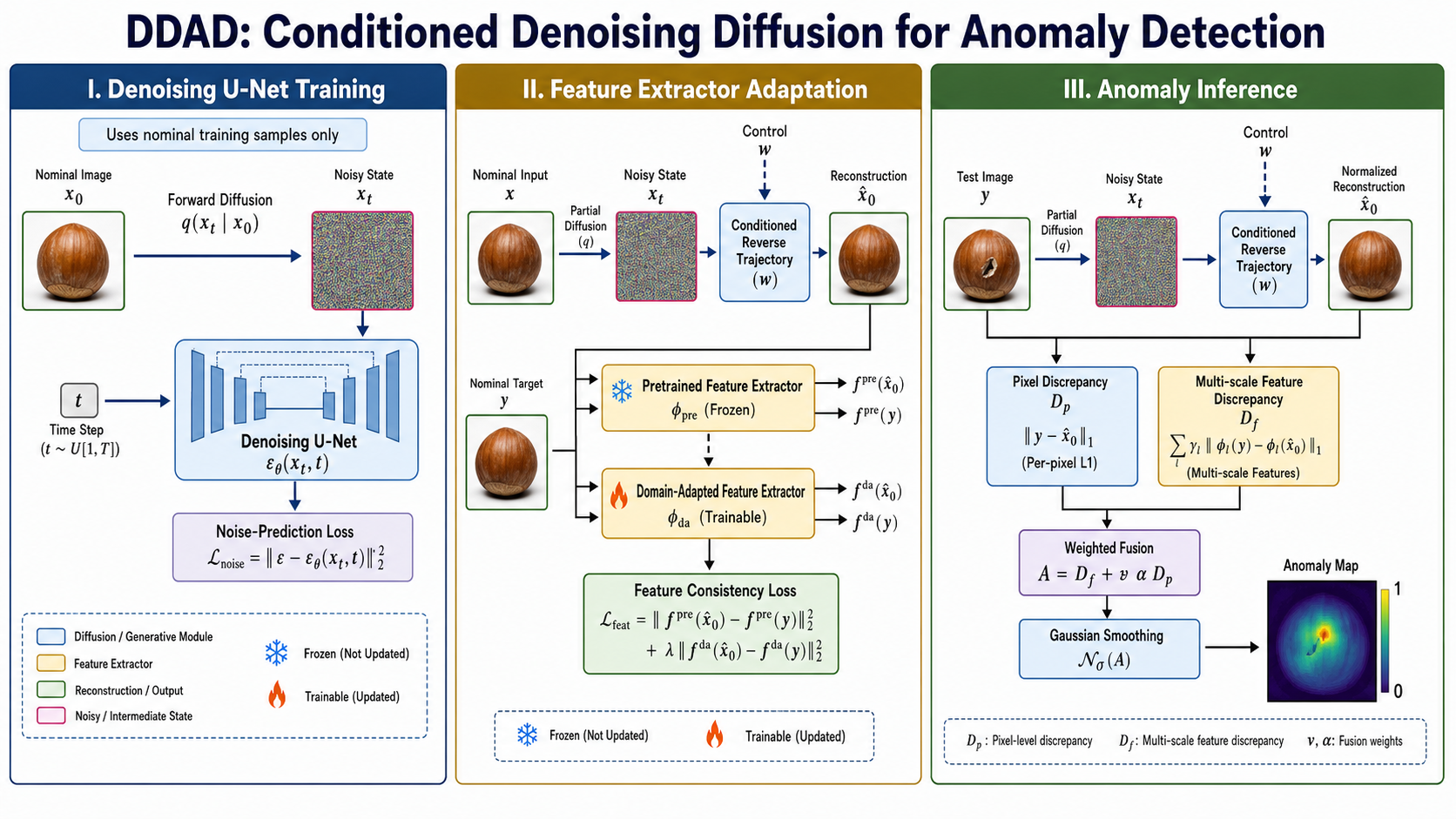
Nominal Hazelnut samples supervise time-conditioned noise prediction across the forward diffusion trajectory.
Official DDAD inference
The interface will reconnect automatically when the inference service is available.